

You cannot hold a stable organic position in ChatGPT. You can make useful pages accessible, keep their claims easy to verify, and study how often answers mention your company or link to your work. Start with crawler access, sound web-search fundamentals, clear answers and the sources already cited for the questions your customers ask. None guarantees a mention or citation.
This guide is for people who build and run digital products: founders, marketers, designers and developers who have noticed that “ChatGPT SEO” has become a line item and want to know what is real. We separate the measurable parts from the folklore.
Key takeaways
- ChatGPT has no fixed ranking. Answers vary from one run to the next, so the right goal is a rising mention rate and citation rate across a stable set of prompts, not a single “#1”.
- Access supports search eligibility. Allow OAI-SearchBot where you want content considered for ChatGPT search; access alone does not secure a citation.
- Google rankings and ChatGPT citations overlap imperfectly. Published studies measure different populations and outcomes, so use them as context for your own audit.
- Give readers a direct answer, traceable facts and tables or FAQs where they help. No verified first-two-sentence rule guarantees extraction.
- Being mentioned and being linked are different outcomes. Measure both.
Why “rank in ChatGPT” is the wrong mental model
A search engine returns a list. ChatGPT returns a composed answer, and the composition changes. Ahrefs describes ChatGPT’s responses as probabilistic: answers can vary across runs, with brands appearing and disappearing from one query to the next. Ask the same question in three sessions and you may see three different sets of names.
That breaks the habit of treating one answer as a ranking check. A single check is an anecdote. Use a fixed sample of customer questions and retain repeated answers with their sources before interpreting a trend.
There is a second reason to be precise about the goal. Rank.ai reports that 61% of 3,930 API answers in its buyer-question sample named no business. The sample used 102 questions from 15 customer accounts and GPT-4o mini with web search between May and October 2026. It is not an estimate for every ChatGPT conversation. An informational answer may need a source without needing to recommend a company.
So replace “rank” with two numbers:
- Mention rate: how often your brand or product appears in answers to a fixed set of prompts.
- Citation rate: how often your specific URL is linked in those answers.
The gap is a place to investigate. A brand can be mentioned while the answer cites an independent review. Your page can be cited for a useful fact without your business being recommended. Inspect the answer and the cited passage before deciding that the page needs a rewrite.
Step 1: Let ChatGPT’s crawler in
Start with access: content improvements cannot help a crawler your infrastructure prevents from reading the page. OpenAI runs several agents, and their access settings are independent:
| User agent | What it does | If you block it |
|---|---|---|
| OAI-SearchBot | Surfaces sites in ChatGPT’s search features | Excluded from search-answer content; navigational links may still appear. |
| GPTBot | Collects content that may be used to train OpenAI’s foundation models | Signals that content should not be used for model training; search crawling is governed independently. |
| ChatGPT-User | Fetches pages for some user-triggered actions; not an automatic search crawler | Its visits do not determine Search inclusion, and robots rules may not apply to user-triggered requests |
You can allow OAI-SearchBot while disallowing GPTBot, keeping search access separate from your training-use policy. OpenAI also recommends allowing requests from its published IP ranges, which matters if a CDN or firewall sits in front of the site.
Access can fail at several layers: a robots policy, a CDN challenge or a page whose main text is unavailable in the returned HTML. Check the actual page and delivery path before commissioning a content rewrite.
A short audit:
- Open yourdomain.com/robots.txt and identify the applicable OAI-SearchBot user-agent group and path rules. Do not assume a wildcard rule overrides a more specific group.
- Check your CDN or web application firewall for bot-protection rules that challenge or block unknown user agents.
- Confirm key pages return a normal 200 response without requiring JavaScript to show the main text.
- After a robots.txt change, allow time for policy adjustment. OpenAI documents approximately 24 hours; that is not a promised discovery or citation deadline.
A normal browser response or a request that merely claims a bot’s user-agent name cannot prove the real crawler reaches the page. Use the published OpenAI bot descriptions and IP ranges when interpreting your server or CDN logs.
Separate permission from delivery
An access audit has three different questions. Record the evidence for each instead of treating a robots.txt change as a visibility result.
| Question | Evidence to collect | What it establishes |
|---|---|---|
| Does the policy allow search crawling? | The applicable OAI-SearchBot rule for this page, including any broader restrictions. | Permission under your published policy. |
| Can a real crawler obtain the content? | Server or CDN logs for requests verified against OpenAI’s published search-bot IP ranges; response status, challenges and returned page content. | Whether those observed requests succeeded. A browser check or a spoofed user agent alone cannot prove this. |
| Does a relevant answer cite the page? | The saved response and the linked source URL for a recorded prompt and run. | A citation in that observation. Successful access does not promise one. |
Step 2: Respect the Google connection, without worshipping it
The studies can sound contradictory because they measure different things: URL overlap, brand order and the chance of any platform citing a page. Keep those outcomes separate before treating a correlation as a content instruction.
Finding one: page one is not enough. Ahrefs’ August 2025 study tested 15,000 long-tail prompts and reported roughly 12% average URL overlap with Google’s top ten across the assistant result types it analyzed. That headline is not a ChatGPT-only percentage, and overlap with the original query is different from overlap with rewritten searches.
Finding two: web-search performance and citations can be associated. AI+Automation’s April 2026 observational preprint reports 54% at Google position one versus about 2% at position 100 for citation by at least one of four tested platforms. Its replication covered 1,998 queries and 94,599 citation events. These are not ChatGPT-only odds or a promised result from improving rank.
These results use different denominators. URL overlap asks whether cited pages also rank for the same query; citation likelihood asks whether a ranking page gets cited; recommendation order asks where a named brand appears. The studies do not prove that Google ranking is a required entry ticket to ChatGPT.
In practice:
- Maintain crawlability, indexing and relevant pages for the questions your customers ask. Investigate the searches and sources visible in your own observations.
- Backlinks or an authority metric alone do not diagnose why an answer chose a source. Inspect the actual passage and question fit.
- Treat any guarantee of placement or a one-day result with suspicion. Policy propagation and citation outcomes are different events.
Keep Google’s own AI features separate. Google says AI Overviews and AI Mode use ordinary SEO requirements: a page must be indexed and eligible for a search snippet, and no special AI markup is required. That guidance applies to Google’s features; it is not documentation of ChatGPT’s selection system.
Step 3: Write pages that can be lifted whole
A useful editing goal is to make each important answer understandable outside the paragraph around it. State what applies, under which conditions and where the evidence comes from. This helps readers assess the claim; it is not a documented formula for winning a ChatGPT citation.
Put the answer in the first two sentences
Under a question-led heading, answer the question before adding supporting context. Treat the first two sentences as an editorial discipline, not a published OpenAI ranking requirement. Keep qualifications that change the meaning alongside the answer.
Compare two openings for an illustrative pricing section:
- Weak: “Pricing depends on several important factors.”
- Specific: “This example assumes a US$100 monthly base fee plus US$0.01 per event. At 20,000 events, the bill is US$300 before tax.”
The calculation is explicit: 100 + (20,000 × 0.01) = 300. These are hypothetical prices, not a vendor quote. The improvement comes from useful detail, not from hitting a two-sentence limit. Our usage-based pricing guide explores the decisions behind such billing models.
Raise fact density
Include the dates, figures, named features, versions and limits that the decision actually requires, and make each claim checkable. Extra statistics that do not change the answer add work for the reader; density alone does not establish a citation advantage.
Use tables and FAQ blocks for the right content
Use tables where the content has comparable fields: pricing tiers, feature differences, turnaround times or requirements. Use FAQs for genuine reader questions. Adding either format does not establish that it caused a citation; AirOps’ observational research found negligible list/table association in its article subset. Don’t pad a page with a table for the sake of it.
Keep it current
When ChatGPT searches, it can use current web sources. Update information when facts change and make meaningful updates visible. Changing a date alone is not evidence that the page became more useful, and not every answer involves a live page fetch.
Step 4: Get named where the model already looks
Your own page is one possible source. A recommendation can name your company while linking to an independent review or comparison. Inspect which pages recur for your actual customer questions before choosing where to invest. A platform’s broad citation frequency is not automatically a channel plan for your business.
What that means for a digital company:
- Earn mentions in places people genuinely discuss your category: independent reviews, industry roundups, community threads where your answer is useful rather than promotional.
- Publish original data, benchmarks or documentation that readers can inspect and other writers can reference.
- Keep verifiable business facts consistent across your site and relevant profiles so readers can resolve discrepancies. Do not treat consistency as a proven model-identity mechanism.
Avoid promotional forum posting aimed at manufacturing mentions. Contribute where your answer helps the discussion, and follow the community’s rules.
Step 5: Measure what you can measure
Build a prompt set before you change anything. Then rerun it on a schedule.
- Write 15 to 30 prompts as a manageable starting scope, not a statistical threshold. Mirror customer problem questions, comparisons and buying questions.
- Run each prompt several times, across sessions. One run proves nothing, given how variable answers are.
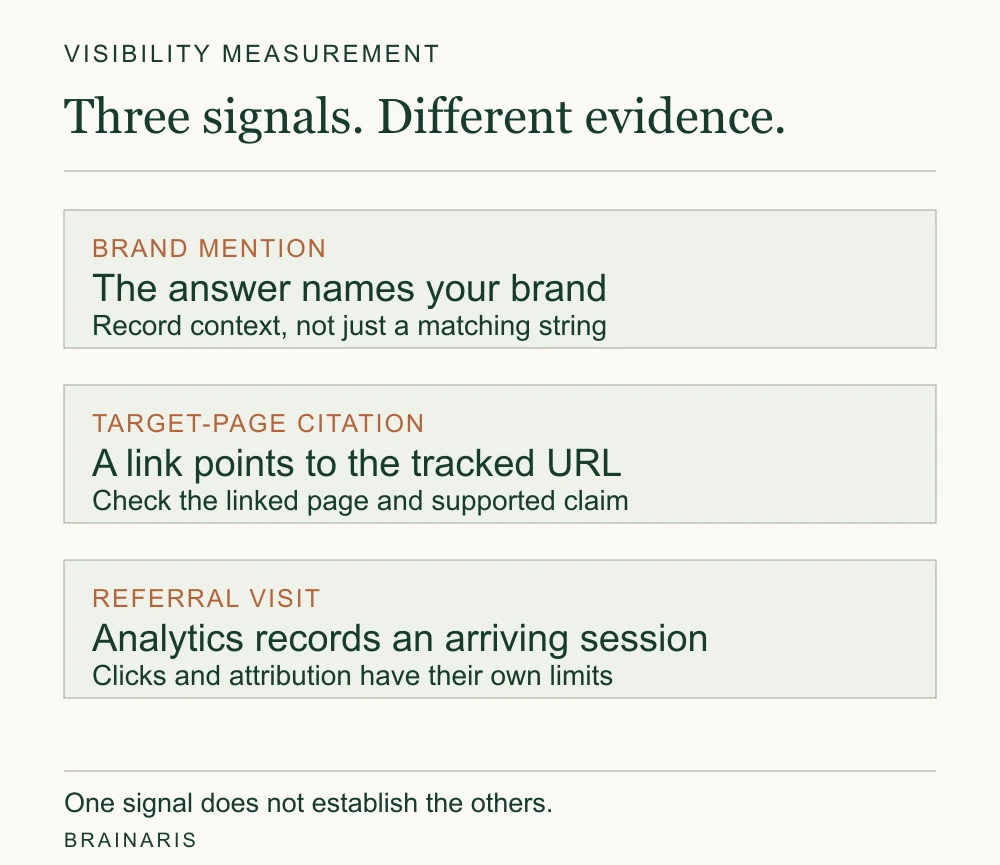
- Log three things: whether your brand is mentioned, whether your URL is cited, and which other sources are cited.
- Compute rates, then watch the trend over comparable rounds. Report the denominator, settings and any excluded technical failures.
- Check referral traffic in your analytics for visits that arrive from ChatGPT. Mentions without clicks are normal, so don’t judge only on visits.
A baseline you can repeat
Start with a small sample you can maintain. For example, choose 15 prompts: five problem questions, five comparisons and five buying questions. Run each three times in fresh conversations for 45 planned observations per review. These counts are a practical starting point, not a statistical minimum.
Record the date, prompt, language, approximate location, product surface, visible model or mode, search setting, sign-in state and memory setting. Keep those conditions stable. Save the full answer and its linked sources; record whether search was used when the interface makes that visible. An API tracker and the ChatGPT app are separate samples.
| Measure | Count | Denominator |
|---|---|---|
| Brand mention rate | Completed answers that name the agreed brand or product alias at least once. | All valid completed answers in this fixed sample. |
| Owned-page citation rate | Completed answers with a linked citation to the target page. Record citations to other pages on your domain separately. | The same valid completed answers. |
| Observed ChatGPT sessions | Sessions attributed to ChatGPT in your website analytics, with your attribution rule recorded. | Report as a separate count for the date window; it is not a percentage of the 45 test answers. |
Illustrative calculation: if all 45 runs complete and nine mention the brand, mention rate is 9 ÷ 45 = 20%. If three cite the target page, page citation rate is 3 ÷ 45 = 6.7%. Several links to that page in one answer still count as one citing answer. Normalize tracking parameters before matching URLs, preserving parameters that identify materially different pages.
Keep completed answers with no mention or no citation in the denominator. Keep completed refusals in the overall denominator and report them separately. Exclude only technical errors or incomplete runs under a rule set before testing, and report planned versus completed counts. If you also calculate a search-only rate, label its smaller denominator; do not silently replace the full sample. Compare prompt groups as well as the total. Small repeated samples and changing models limit what a trend can establish, and a before-and-after change alone does not prove your edit caused it.
Read the result before prescribing a fix. If the brand is mentioned without an owned-page citation, inspect the independent review or other page the answer links. If your page is cited without a recommendation, check whether the prompt asked for information rather than a product shortlist. If neither appears, check verified access and question fit. If citations produce few visits, check link behavior and analytics attribution before judging the content.
OpenAI’s search documentation explains that ChatGPT can rewrite a question and use search partners. Log the answer you actually observed instead of assuming the original prompt was the only query used.
Use the source review to choose the next check, rather than automatically restructuring the page. The metric identifies an observation; the answer, cited passage and access evidence help explain it. If you are considering a paid tracker, compare that additional evidence and maintenance work with the manual baseline before deciding what to build or buy.
What to ignore
- Keyword stuffing and “brute force” repetition. A model evaluating a page for an answer wants clarity, not repetition.
- Guaranteed placement. Nobody can promise it, because the output is probabilistic.
- Copying competitors wholesale. Study what gets cited, then add something they lack: original numbers, clearer structure, firsthand experience.
- Blocking everything out of fear. Blocking GPTBot is a legitimate training-use choice. Blocking OAI-SearchBot excludes content from search answers, although navigational links may still appear.
Our perspective
The practical question is where to spend the next hour: repairing access, improving an answer or investigating how the category is described elsewhere. A visibility report is useful when it helps make that choice.
Clear answers, specific facts, honest sourcing and meaningful updates already help a busy practitioner judge a page. They are sound editorial choices even where a measured citation benefit remains unknown. The practitioner is the reader we care about.
We would be wary of any tactic that makes a page worse for a human in exchange for a hypothetical edge with a model. A table that clarifies a comparison is good. Text written to be scraped is not. If a change would embarrass you in front of a colleague reading the page, skip it.
Measure patiently. Repeated comparable runs show what happened in the chosen sample; a lucky screenshot does not establish a trend. A month is an observation window, not statistical assurance, and changing prompts or settings makes comparison harder.
That is also how we approach our own work: considered, practitioner-oriented pieces on design, development, AI and growth, built to be used in real decisions rather than to chase headlines. Our standards for sourcing and corrections are set out in our editorial policy.
Keep reading with Brainaris
Brainaris publishes practical work on design, development, AI and growth. Read our editorial policy for the approach to evidence and corrections, or explore the published guides.
A practical checklist
Use this as a one-page audit for any key page:
| Check | What good looks like |
|---|---|
| Crawl access | OAI-SearchBot allowed in robots.txt and not blocked by CDN or firewall |
| Web search visibility | Indexed, relevant pages for the questions customers ask; visibility is not a citation guarantee. |
| Headings | Clear, descriptive H2/H3 labels; question headings where they suit the content. |
| Opening lines | A direct answer early in the section, with necessary conditions kept alongside it. |
| Facts | Decision-relevant facts, figures and limits traceable to their sources. |
| Structure | Table or FAQ where the content is truly comparative or question-led |
| Freshness | Visible update date and current numbers |
| Off-site presence | Consistent, useful mentions on reference and community sites |
| Measurement | Fixed prompts and settings, visible denominators, and separate mentions, citations and referral visits. |
FAQ
How do I rank in ChatGPT?
You cannot hold a fixed organic position across changing ChatGPT answers. Make relevant pages accessible, publish clear and supported answers, and inspect the sources used for your customer questions. Track brand mentions, linked citations and referral visits separately. These actions improve the basis for discovery and evaluation; none guarantees inclusion.
How fast can you rank on ChatGPT?
Nobody can promise a timeline. OpenAI documents roughly 24 hours for robots-policy adjustment, which is different from fetching a page or selecting it for an answer. Record repeated observations under comparable conditions; do not infer a citation deadline from crawl policy timing.
Does ranking on Google help me show up in ChatGPT?
Good web-search visibility may help discovery, but the evidence does not establish a required Google position. Published studies measure different platforms and outcomes. A Google ranking, an observed ChatGPT citation and a brand recommendation are separate observations; verify each before diagnosing the gap.
Should I block GPTBot?
That is your training-use policy decision. OpenAI documents GPTBot and OAI-SearchBot independently, so you can disallow GPTBot while allowing search crawling. This does not erase prior training or guarantee a citation. OAI-SearchBot opt-outs can still appear as navigational links.
Sources
- Overview of OpenAI Crawlers
- Query Intent and Google Rank as Joint Predictors of AI Citation
- How to rank in ChatGPT: what decides who it names
- How to Rank on ChatGPT: What Actually Works
- Ahrefs: original 15,000-prompt search-overlap study
- AI+Automation: observational citation preprint and methods
- AirOps: retrieval, fan-out and citation observations
- OpenAI: searching the web with ChatGPT
- Google Search: AI features and website eligibility
Sources checked October 22, 2026. Proposed monitoring counts and the pricing calculation are illustrative, not Brainaris performance results. Observational studies do not establish a guaranteed citation tactic.